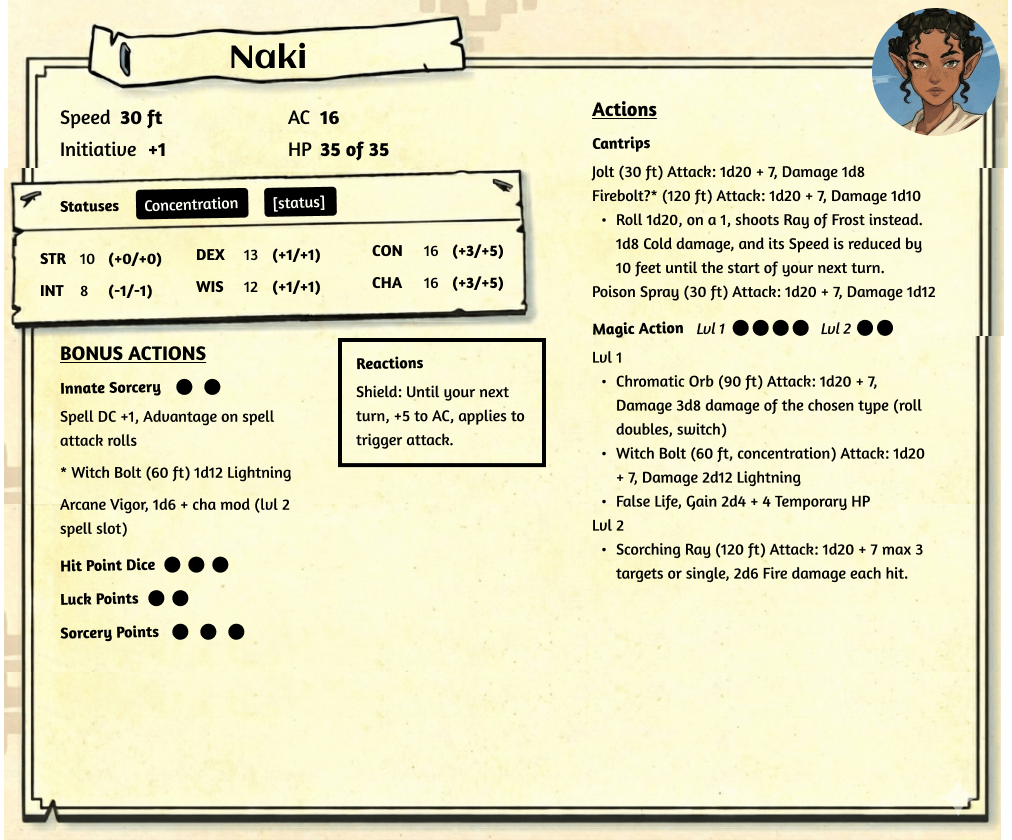
The Challenge As a first-time Game Master running a campaign in the Obojima setting, my primary goal is absolute immersion. However, my “users”—my players—are entirely new to tabletop RPGs. The learning curve was so steep that during our session zero, I actually had to pause to explain the fundamental concept of “hit points.”
I needed a way to present highly complex, varied character data at the exact right moment, without the intimidating, cognitive overload of the Player’s Handbook. Furthermore, because this is a hobby project with limited hours, an agile, highly iterative approach was essential to keep the campaign moving.
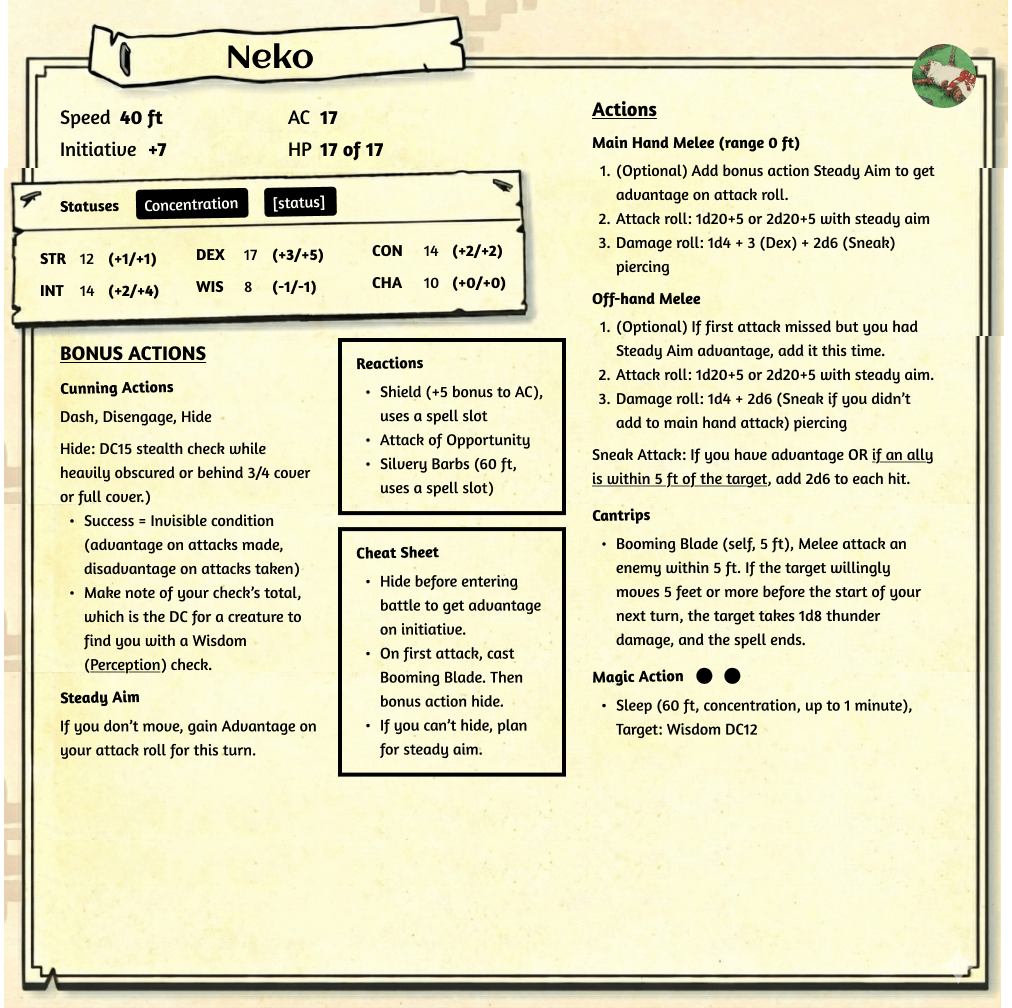
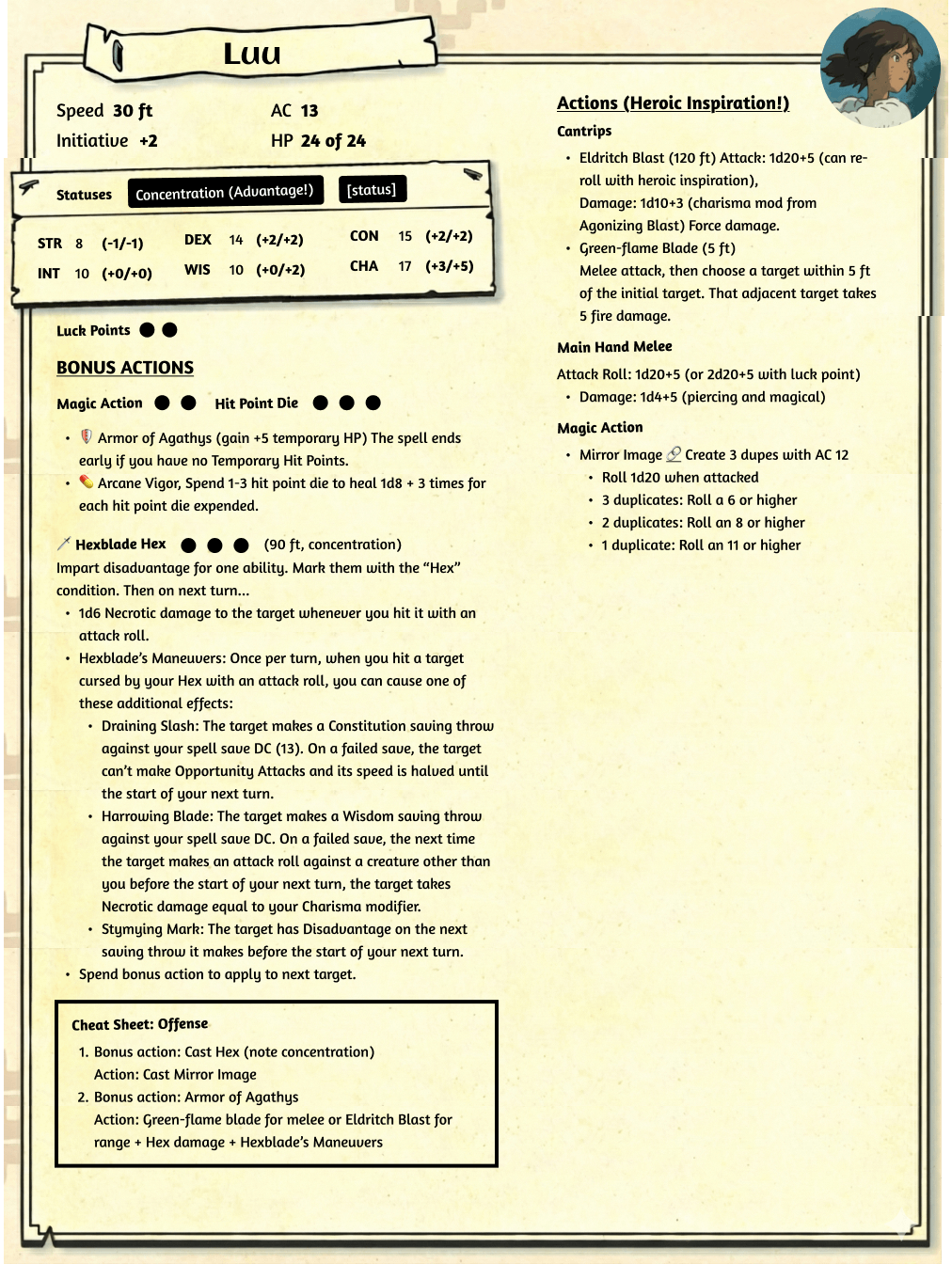
The Action I approached the character sheets as a complex data-synthesis problem, tackling each character card individually to truly understand the massive variance in their information needs.
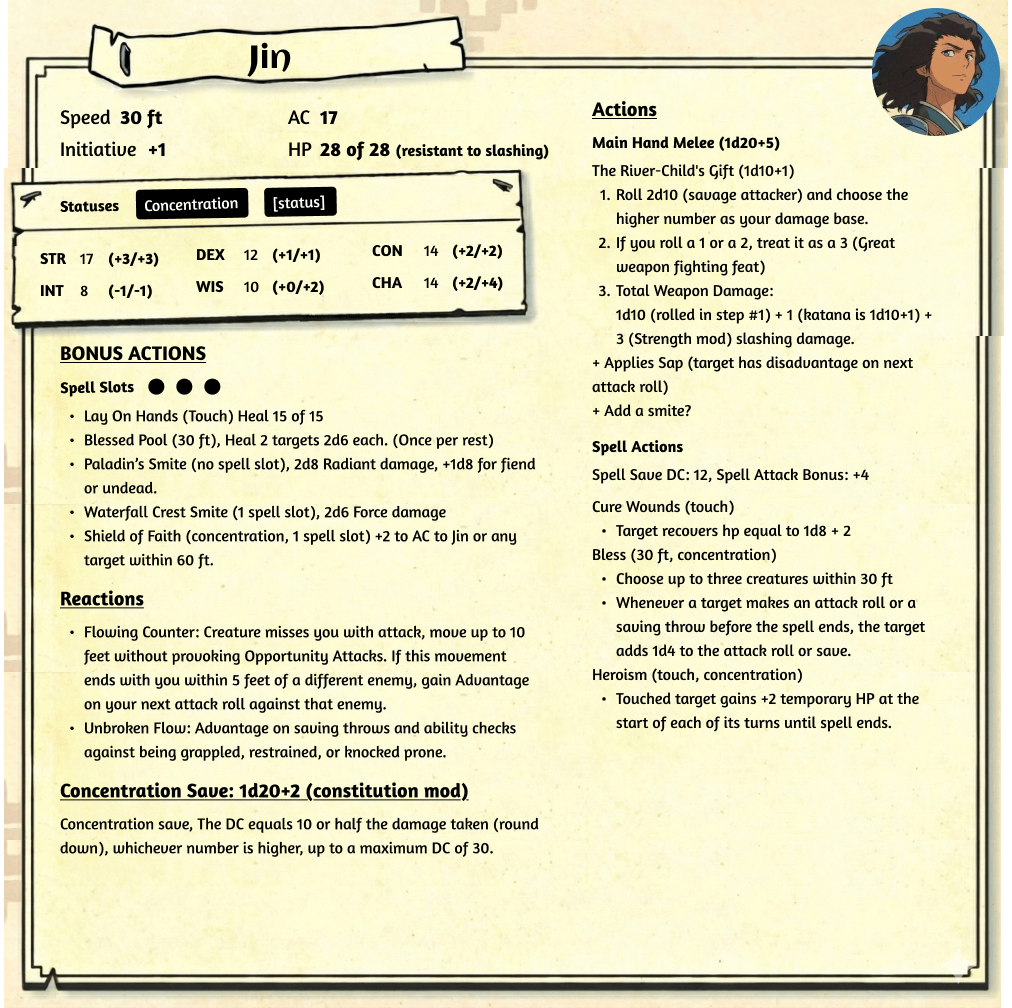
Systems Thinking: I designed a flexible UI template that maintained strict visual consistency. This allowed me, as the GM, to rapidly scan and digest any character’s card in quick succession during a chaotic encounter.
Progressive Disclosure: I optimized the arrangement of information for each specific class. For example, Jin (a Paladin) relies heavily on concentration spells, so I surfaced the mechanics of “Concentration” directly on his UI. Conversely, Neko (a Rogue) relies on stealth, so his card features a detailed, localized breakdown of the “Hide” mechanic.
Data Synthesis: I consolidated complex rules from D&D Beyond, the Obojima Settings book, and other supplementary sources into a single, unified visual language so the experience felt seamless.
The Impact & Iterative Loop The custom cards drastically streamlined our encounters. Players no longer need to break immersion to sift through spell cards or flip through the PHB; the exact mechanics they need are presented in the context in which they need them.
More importantly, these cards act as a living product driven by continuous user feedback. For example, Jin’s card includes the “Concentration” rules as training wheels for the first half of the campaign. Once that mechanic becomes second nature to the player, we iterate and remove that block of text to free up UI space. The design adapts to the user’s growing expertise.
Future Explorations & Next Steps To continue scaling this system as the players level up, I am currently exploring:
Contextual Views: Should there be distinct UI toggles for a “Battle View” versus an “Exploration View”?
Interactive Prototyping: How can I leverage Figma prototypes to make the cards interactive, streamlining the initial view while allowing players to tap for deeper context on demand?
GM Dashboarding: What is the best way to harness Figma to build a holistic navigation system, allowing me to seamlessly jump between all character cards and NPC stats behind the DM screen?
Design Ops: How can the underlying component structure be improved so that updating a card takes minutes instead of hours when a character levels up?
Edge Cases: How might the layout need to fundamentally flex to accommodate the massive, chunky spellbooks of high-level Wizards or Druids?